
Significant figures (sig figs) are used to indicate the precision of a measured number. Significant figures are the digits in a measured number that are known with certainty plus one last digit which is less certain.
Rules For Significant Figures
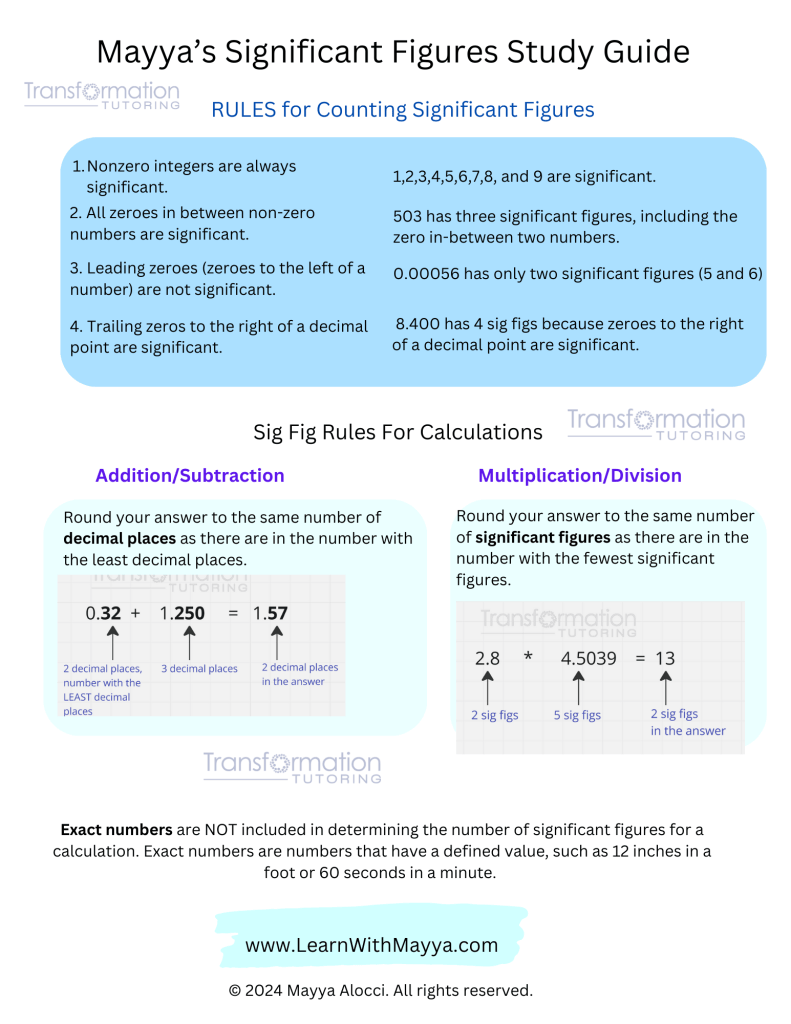
- All non-zero digits are significant. This means all numbers: 1,2,3,4,5,6,7,8, and 9 are significant. For example 3.6 has two significant figures.
- All zeroes in between non-zero numbers are significant. For example, 503 has three significant figures, including the zero in-between two numbers.
- Leading zeroes (zeroes to the left of a number) are not significant. For example: 0.00056 has only two significant figures (5 and 6).
- Trailing zeros to the right of a decimal point are significant. For example zeroes in 8.400 are significant.
- Terminal zeros in a number without an explicit decimal point may or may not be significant (for example 300). To remove the confusion, we should write out these number using scientific notation.
How many significant figures are in the following numbers?
786
SOLUTION
3 significant figures
1.20
SOLUTION
3 significant figures
2006
SOLUTION
4 significant figures
4.0500
SOLUTION
5 significant figures
0.4
SOLUTION
1 significant figure
0.003060
SOLUTION
4 significant figures
Significant Figures in Calculations
Addition And Subtraction
When adding or subtracting, round your answer to the same number of decimal places as there are in the number with the least decimal places.
For example, 0.32 + 1.250
The first number (0.32) has two decimal places while the second number (1.250) has three decimal place. 0.32 is the number with the least decimal places. Therefore, we should round our answer to two decimal place. 0.32 + 1.250= 1.57
Multiplication and Division
When multiplying or dividing, round your answer to the same number of significant figures as there are in the number with the fewest significant figures.
For example, 2.8*4.5039
The first number has 2.8 has 2 significant figures and the second number, 4.5039 has 5 significant figures. 2.8 is the number with the least significant figures. Therefore, we should round the answer to 2 significant figures.
2.8*4.5039 = 13
Multistep Calculations
If there is a multistep problem, never round off your answer during a the process. Only round off at the very end!
Extra Notes:
- Exact numbers are NOT included in determining the number of significant figures for a calculation. Exact numbers are numbers that have a defined value, such as 12 inches in a foot or 60 seconds in a minute.
For example, if the question asks how many seconds are there in 2.56 minutes? 2.56minutes*60 seconds/1 minute = 153.6 To get the correct number of sig figs, you need to take into account 2.56 minutes only since 60 seconds is an exact number. 2.56 minutes has three significant figures. We need to round the answer to three sig figs as well, 154 seconds. - When rounding, if the digit is less than 5, keep the number before it and drop everything else. For example, rounding 2.343 to two significant figures, gives 2.3. When rounding, if the digit is 5 or greater, add 1 to the number before it and drop everything else. For example, rounding 5.68 to two significant figures, gives 5.7.
Scientific Notation
Scientific notation is useful in representing very big or very small numbers and clarifying the number significant figures. Scientific notation is in the form of A *10n , where A has one nonzero number to the left of the decimal point. For example, 5.60 *10-4.
How to write a number using scientific notation?
1. Move the decimal point in the number until there is only one non-zero digit to its left.
2. If you moved the decimal to the left, the exponent (subscript of 10) is positive. If you moved the decimal to the right, the exponent is negative.
Number of spaces you moved is equal to the exponent for 10.
Example: 45000 = 4.5000 *104 because you had to move 4 spaces to the left. 0.0045 = 4.5*103 because you had to move 3 spaces to the right.
LINKS
General Chemistry Course
Online General Chemistry Tutor
Find me on Youtube
Find me on TikTok
Learn more about Transformation Tutoring
References:
General Chemistry by Ebbing and Gammon
Chemistry The Central Science by Brown, LeMay, Bursten, Murphy, Woodward, Stoltzfus
Contact Us To Set Up A Session With General Chemistry Tutor Online

